
Fabric cutting might look like a straightforward job roll out the cloth, follow a pattern, and slice along the lines. Yet professionals know that cutting isn’t simply the first step in making a garment. It is the engineering phase that defines how a piece will drape, fit, and perform once it’s stitched together. Every millimetre, every grain direction, and every cut angle has a scientific consequence.
When it comes to sewing or small-scale production, the first cut can decide everything about how your garment hangs, how long it lasts, and how much material you waste. Behind every polished dress, cushion cover, or craft item is one essential process of professional fabric cutting. Done correctly, it saves hours of correction work and prevents costly fabric wastage.
For anyone who sews at scale, from independent designers and craft sellers to small-batch manufacturers, understanding what truly happens during the cutting stage can transform productivity, reduce waste, and improve profit margins.
Let’s look at the anatomy of precision cutting and explore why professionals invest so much care, equipment, and expertise into something that seems deceptively simple.
1. The Behaviour of Fabrics: Why They Don’t All Cut the Same?
Every fabric type has its own internal structure. Some are knitted, some woven, some bonded or pile-based. These construction differences determine how the fibres react to pressure, friction, and heat during cutting. Professionals study this “material behaviour logic” to decide how to cut, not just where.
|
Fabric Type |
How It Behaves When Cut |
Professional Technique Applied |
Potential Issue if Mishandled |
|
Jersey (knits) |
Loops relax and edges curl outward once tension releases. |
Stabilised with light fusible interfacing or paper backing before cutting. |
Distorted pattern pieces, uneven hems. |
|
Velvet / Fleece |
Directional nap; pile compresses or shifts. |
Cut pile-side down using vacuum tables or low-pressure rotary blades. |
Uneven colour tone and mismatched nap direction. |
|
Woven Cotton |
Threads separate easily at the edge. |
Minimal handling, ultra-sharp shears, clean single-pass cuts. |
Fraying and dimensional loss. |
|
Satin / Chiffon |
Extremely smooth surface; slides under pressure. |
Sandwiched between tissue paper or pinned in layers for grip. |
Skewed pattern shapes, inaccurate seams. |
|
Polyester / Nylon |
Melts slightly under friction or heat. |
Laser or hot-knife cutting seals edge automatically. |
Ragged finish or melted distortions if overheated. |

This kind of knowledge doesn’t come from guesswork. It’s built from experience and textile science.
Professionals understand that the physical stress of cutting affects the weave tension, which directly impacts how the fabric will sew and drape later. A cut that looks neat on the table may behave completely differently once the piece is lifted or stitched.
2. Grainline, Bias & The Geometry of Drape
The grainline is the invisible architecture of every fabric. It defines how the threads run vertically (warp) and horizontally (weft) and therefore how the material behaves under gravity. Cutting along or across these lines changes everything.
-
On-grain cutting produces stability and clean structure. It’s what you need for crisp shirts, tailored trousers, or upholstery panels that must hold their shape.
-
Bias cutting (at roughly 45° to the grain) creates flexibility and elegant movement. It’s perfect for evening gowns, scarves, and draped blouses.
- Cross-grain cutting uses the weft’s stretch intentionally, often in knit garments, to allow freedom of movement.
Professionals don’t merely align pattern pieces visually; they calculate grain deviation. Even a half-degree misalignment can cause a garment to twist after washing. That’s why skilled cutters mark and square fabric carefully before the first blade touches cloth.
When you invest in a professional cutting service, you’re essentially paying for that accuracy a guarantee that every piece is perfectly squared to the intended grainline, ensuring consistent drape and fit across an entire batch.
3. Precision Parameters: Why Millimetres Matter
A single garment may include dozens of panels, notches, and seam allowances. If each one is even a millimetre off, by the time they’re sewn together, the mismatch can be visible and costly. That’s why professionals treat cutting as a precision operation with measurable parameters.
Tolerance control:
High-quality cutting maintains accuracy within ±1 mm. That may sound extreme, but think about a fitted dress or cushion cover, one millimetre at each seam can accumulate to over a centimetre of misfit.
Layout efficiency:
Another hidden benefit is layout planning. Professionals use “nested pattern layouts”, digital or manual arrangements of pattern pieces that interlock like puzzle shapes to reduce off-cut waste. With careful nesting, material usage can improve from 80% to 95%, directly saving both fabric and money.
Environmental and cost impact:
A 10% improvement in yield on a 50-metre roll of fabric means five extra metres of usable material. Across hundreds of production runs, that difference pays for the cutting service itself many times over.
4. The Physics and Engineering of the Cutting Process
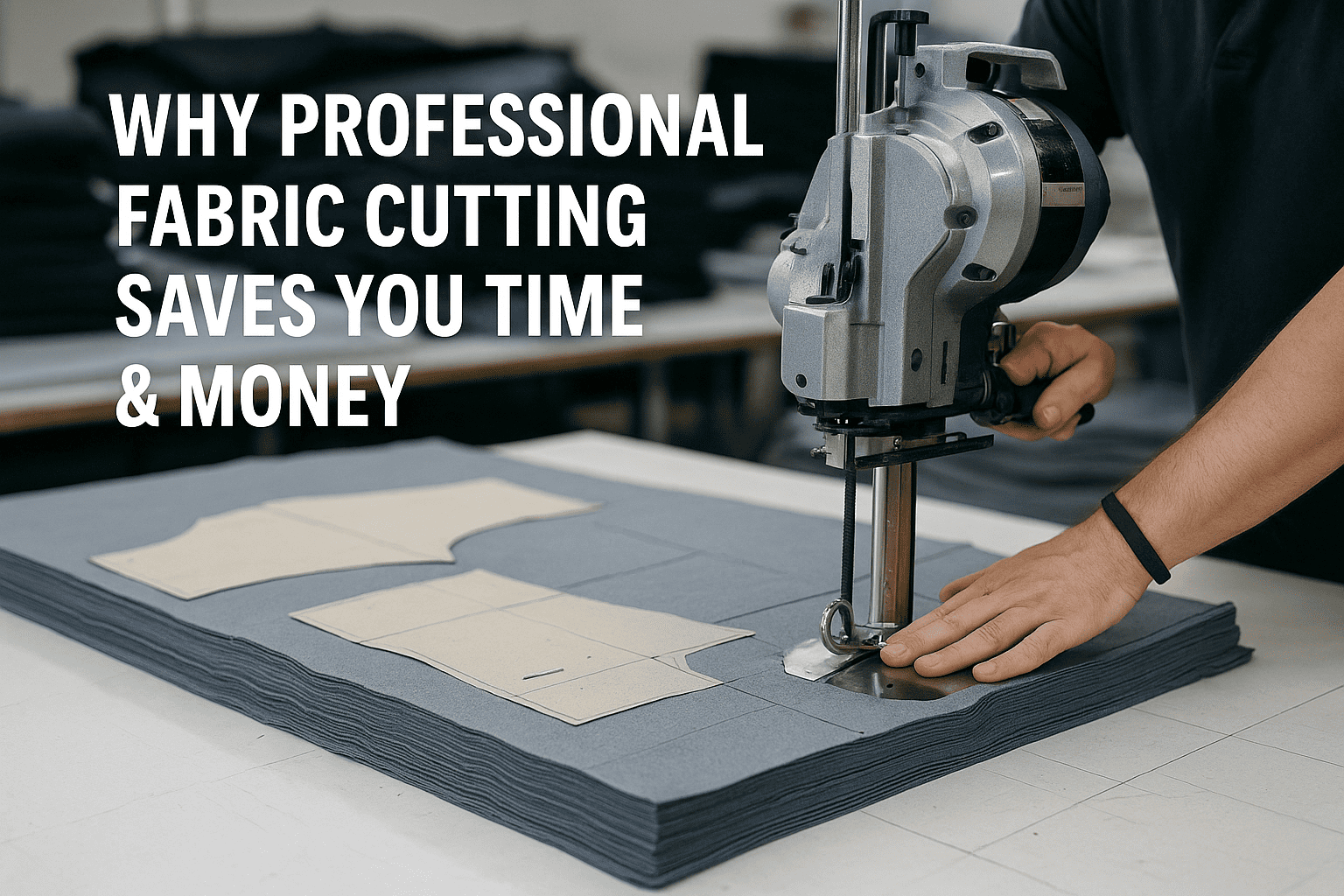
Professional cutting isn’t just about sharp scissors. It’s a controlled engineering process combining force, friction, and fibre response.
Blade and Surface Interaction
When a blade moves through fabric, friction generates micro-heat. Synthetic fibres like polyester soften under that heat, slightly sealing their edges a natural advantage. Natural fibres such as cotton, however, don’t melt; they fray if the blade isn’t sharp enough or if pressure drags fibres sideways.
Professionals use low-friction cutting mats, Teflon-coated surfaces, and variable-speed rotary blades to manage this interaction.
Pressure Control
Too much downward pressure distorts the weave before the cut is made, especially on knits and velvets. Expert cutters adjust blade weight and speed to maintain edge integrity.
For fleece, slowing the blade rotation reduces edge fuzzing. For stretch velvet, dual-layer vacuum systems hold both layers steady while slicing cleanly through the pile, preventing nap shift.
Technology Integration
Modern cutting rooms often combine mechanical precision with computerised control:
- Rotary cutters deliver high-speed, low-drag precision for straight lines and curves.
- Laser cutters are ideal for synthetics, where sealed edges prevent fray.
- Automated plotter cutters read digital pattern files, reproducing complex layouts at industrial speed.
The key advantage is repeatability. Whether it’s one metre or a thousand, each panel comes out identical no human variation, no guesswork.
5. Material Science in Action: What Really Happens When You Cut
To appreciate the science behind fabric cutting, it helps to look at fibre composition. Each fibre type reacts differently to cutting stress, moisture, and heat.
Cotton
A cellulose-based natural fibre, cotton is strong but frays easily. It needs a clean, single pass from a sharp blade. Repeated sawing motions roughen the edges and weaken the weave. Professionals use rotary cutters or laser edges to minimise fibre separation.
Polyester
A synthetic polymer that softens around 230 °C. Laser cutting slightly melts the cross-section, fusing the threads. This creates a perfect sealed edge no fraying, no overlocking needed for internal seams.
Wool
Elastic and dense, wool resists friction but can compress. Cutting too quickly or with blunt blades causes dragging and uneven edges. Professionals often stretch and relax wool before cutting to stabilise the grain.
Silk and Chiffon
These fibres are delicate and slippery because of their smooth molecular structure. Even breathing over them can shift layers. To counteract this, professionals place a lightweight tissue sheet above and below, locking the fabric in place during cutting.
Velvet
Velvet’s cut-pile surface demands special handling. Professionals cut pile-side down to avoid bruising the texture. They may use micro-toothed rotary blades that slice cleanly between fibres rather than crushing them.
6. Tangible Real-World Examples
Example 1: Stretch Velvet
Cutting stretch velvet manually can distort the pile direction and cause one side of a garment to appear darker than the other under light.
Professional cutters handle it differently. They lay two layers nap-to-nap, stabilise with vacuum suction, and make a single clean pass. The result is perfect symmetry, preserved texture, and zero stretch distortion.
Example 2: Fleece for Activewear
Fleece’s brushed surface can fuzz at the edges when cut too fast. Professionals adjust blade speed and pressure so the cut edge remains dense and smooth, saving finishing time. This ensures seams align beautifully and garments look retail-ready.
Example 3: Chiffon Gowns
A designer might spend hours adjusting a mis-cut chiffon skirt that flares unevenly. Professionals sandwich the chiffon with tissue paper, cut both together, and achieve identical panels. Less trimming, faster sewing, and perfect flow.
Each example highlights one truth: the more precise the cut, the fewer problems appear later.
Why Professional Cutting Translates Directly into Savings?
Time, material, and reputation all have measurable value. Here’s how professional cutting impacts each one.
Material Savings
Optimised nesting means up to 10–15% less waste. For small businesses, that could save dozens of metres of premium fabric every month.
Reduced Labour Hours
When panels fit perfectly, seamstresses spend less time adjusting or trimming. A 20-minute time saving per garment multiplied by hundreds of pieces adds up quickly.
Improved Consistency
Uniform pieces mean fewer rejects and easier quality control. That reliability builds customer trust and repeat orders.
Enhanced Final Quality
Even the most skilled machinist can’t compensate for an inaccurate cut. Correct grain alignment and sharp, sealed edges ensure every seam matches, every drape hangs naturally, and every product looks professional.
Lower Equipment Costs Over Time
Constant re-cutting and waste dull blades faster and consume extra energy. Professionals plan every move for efficiency, which indirectly reduces operational expenses for manufacturers who outsource the process.
The Psychology of Precision
Precision doesn’t just improve fabric performance, it changes how creators think about their work. Knowing your materials are cut perfectly builds confidence in your craftsmanship. Designers can focus on creativity rather than correction. Manufacturers gain predictability and workflow stability.
There’s also an emotional benefit for customers. When they receive a garment that fits flawlessly, they perceive value. That perception feeds brand reputation. Behind that satisfaction lies the unseen accuracy of the cutter’s hand.
Evaluating a Cutting Service: What to Look For?
If you’re considering outsourcing or upgrading your process, ask these key questions:
1. Do they understand fabric behaviour?
Look for evidence that they adapt techniques per fabric type, not a one-size-fits-all approach.
2. What’s their tolerance range?
Anything beyond ±1 mm in high-value textiles can be risky.
3. How efficient is their layout planning?
Request data or samples showing material yield percentages.
4. What technology do they use?
Rotary, laser, or vacuum systems each suit different materials good services invest in all three.
Do they provide sample cuts or trials?
A professional service should offer small-batch tests so you can verify consistency before committing large orders.
A trustworthy cutting partner will discuss your fabric composition, intended use, and production volume openly because professional cutting is a partnership, not a transaction.
DIY vs Professional Cutting

Imagine two identical rolls of stretch jersey laid out on separate tables. On one, a home sewer measures, pins, and cuts by hand. On the other, a professional uses stabilisers, calibrated rulers, and a rotary system.
The home-cut panels curl, edges distort slightly, and seam allowances vary by a few millimetres. Sewing takes longer because every seam needs adjusting.
The professionally cut panels lie flat, align perfectly, and sew together like puzzle pieces. No stretching, no trimming, no waste.
By the end, the home project looks handmade. The professional version looks market-ready. The cost difference at the start was just a cutting fee the value gained shows in every stitch.
The Broader Impact: Sustainability and Scalability
Cutting efficiency directly supports sustainability. Less waste means fewer off-cuts sent to landfill and lower energy use across production. Many professional services now track yield percentages to prove environmental responsibility.
For growing brands, scalable precision also means predictable costing. When every metre counts, it becomes easier to forecast budgets, price products fairly, and compete confidently in the marketplace.
Conclusion:
Fabric cutting services is where art meets engineering. It combines the tactile intuition of a craftsman with the technical discipline of an engineer.
Understanding material behaviour from jersey curls to velvet nap, from grain alignment to fibre reaction, turns an everyday task into a controlled process of precision.
When you choose professional cutting, you’re not paying for someone to use a sharper pair of scissors. You’re investing in:
- Consistent, measurable quality.
- Reduced waste and faster production.
- Better drape, alignment, and longevity in every finished item.
- The confidence that what you sew will look and perform exactly as intended.
So next time you unroll a bolt of fabric, remember the smartest saving you can make isn’t by buying cheaper cloth. It’s by ensuring every centimetre of it is cut professionally right the first time.